

Home Blog Page 127

RBI JE Recruitment 2021:For Civil And Electrical Engineers

0

RBI JE Recruitment 2021 :  Reserve Bank of India (RBI) has released a job notification for the recruitment of Junior Engineers (Civil/ Electrical) vacancy. The advertisement is published in the local newspapers. There is total number of vacancies is 48 and  interested & eligible candidates can apply online.  We are providing you all the details regarding the notification in this article. You can see the published short notice of the Reserve Bank of India below.
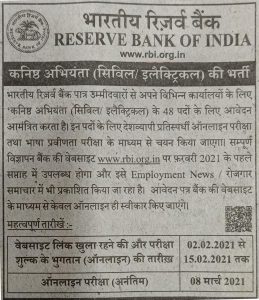
RBI JE Notification

Online Application link will be activated soon. 

RBI JE Recruitment 2021

1. Junior Engineer (Civil)

2. Junior Engineer (Electrical)

Important Dates of RBI JE Recruitment 2021

Starting Date to Apply Online & Payment of Fee: 02 Feb 2021
 Last Date to Apply Online & Payment of Fee: 15 Feb 2021
 Date of Online Examination (Tentative): 08 March 2021

Eligibility Criteria of RBI JE Recruitment 2021

Junior Engineer (Civil): Minimum three years Diploma in Civil Engineering from a recognised Institute or University or Board with minimum 65% of marks (55% for SC/ST/PWD) or Degree in Civil Engineering from a recognised University with 55% marks (45% for SC/ST/PWD).

Junior Engineer (Electrical): Minimum three years Diploma in Electrical or Electrical and Electronic Engineering from a recognized Institute or University or Board with minimum 65% of marks (55% for SC/ST/PWD) or Degree in Electrical or Electrical and Electronic Engineering from a recognized University with 55% marks (45% for SC/ST/PWD).

Age Limit :

Between 20 and 30 years. Upper age limit will be relaxed as per rule.

Selection Process of RBI JE Recruitment

Selection will be through Online Examination and Language Proficiency Test (LPT).

Experience:

Junior Engineer (Civil): At least 2 years’ experience for Diploma holders or at least 1-year experience for Degree holders in execution and supervision of civil construction work and/ or civil maintenance of office buildings/ commercial buildings/ residential complexes with basic knowledge of RCC design and other civil works, working knowledge of computers, experience in preparation of tenders for civil works, etc.

Junior Engineer (Electrical): At least 2 years’ experience for Diploma holders or at least 1-year experience for Degree holders in execution and supervision of electrical installations in large buildings/ commercial buildings having HT/ LT substations, central AC plants, lifts, UPS, DG sets, CCTV, Fire alarm system, etc.

IBPS RRB PO Mains Exam Analysis 30 January 2021

0

IBPS RRB PO Mains Exam Analysis 30 January 2021: The Institute of Banking Personnel Selection will be conducting the IBPS RRB PO Mains Exam 2021 on 30th January 2021. Candidates appearing for this exam are curious to know what could be the difficulty level of this year’s IBPS RRB Mains exam for the post of probationary officer. In this article, we will be looking at IBPS RRB PO Mains 2021 Analysis to give the aspirants an overview of the upcoming Mains Exam of IBPS RRB PO 2021.

IBPS RRB PO Mains Exam Analysis 30 January 2021

IBPS RRB PO Mains Exam Analysis 2021: Exam Pattern

Before going further, let’s have a look at what was the exam pattern of IBPS RRB PO Mains Exam 2021. Below is the section-wise distribution of the exam. The total duration of the exam is 2 hours, which candidates have to distribute accordingly.

SNoSectionQuestions AskedMaximum Marks
1Reasoning4050
2General Awareness4040
3Numerical Ability4050
4English/Hindi Language4040
5Computer Knowledge4020
Total200200

IBPS RRB PO Mains Exam Analysis 2021: Good Attempts

Here we present the number of good attempts for the reasoning section, numerical ability section, and overall good attempts which a candidate must do in the today’s IBPS RRB PO Mains exam. This is a good attempt for the general category, for other categories reduce your attempt by 5-6 questions, depending upon your category.

SNoSectionGood AttemptsDifficulty Level
1Reasoning32-34Easy
2General Awareness25-28Easy to Moderate
3Numerical Ability16-18Easy to Moderate
4English/Hindi Language24-26Easy to Moderate
5Computer Knowledge20-22Easy
Overall Attempts117-128Easy to Moderate

IBPS RRB PO Mains Exam 2021: Section-wise Analysis

Reasoning Ability

The reasoning section of the IBPS RRB Officer Scale I Mains exam was of Easy Level. Given below is the exam analysis for the reasoning ability section:

Puzzles questions Asked:

  • Uncertain Linear Puzzle (North Facing)- 03 Questions
  • Day Based Puzzle (5 Days)- 1 Question
  • Circular Based Puzzle (Age Based)- 5 Questions
  • Box Based Puzzle (2 variables)- 5 Questions
TopicsNo. of QuestionsDifficulty Level
Puzzles14Easy to Moderate
Inequality03Easy
Directions01Easy
Miscellaneous (Substitution Coding)01Easy
Blood Relations03Easy
Data Sufficiency05Easy
Logical Reasoning05-06Easy

Quantitative Aptitude

The quantitative aptitude section of the IBPS RRB PO Mains Exam was of Easy to Moderate level. The candidates can refer to the below-mentioned information to know the detailed distribution of questions in the quantitative aptitude section.

Data Interpretation Questions:

  • Tabular DI (Laptop, Desktop, Macbook)
  • Caselet DI (Profit-Loss Based)
TopicsNo. of QuestionsDifficulty Level
Data Interpretation10Easy to Moderate
Data Sufficiency05Easy
Missing Number Series05Easy to Moderate
Arithmetic (Word Problem)10Easy to Moderate
Pie Chart05Easy to Moderate
Caselet05Easy to Moderate

English/Hindi Language

The English language section of the IBPS RRB Officer Scale I exam was Easy to Moderate and given below is the distribution of questions based on the questions asked in the Mains Exam 2021 paper:

English Language

TopicsNo. of QuestionsDifficulty Level
Filler05-06Easy to Moderate
Comprehension09Easy to Moderate
Error Detection05Easy
Rearrangement05-06Easy
Word ReplacementEasy to Moderate

General Awareness

Static GK, Current Affairs and General  Awareness are all a part of this section. Some of the questions asked in IBPS RRB PO Mains Exam on 30th January 2021 has been provided here:

  1. G20 Summit Theme
  2. Mudra Scheme- Limit Taran
  3. International Mountain Day Theme
  4. A Song of India Book
  5. Budget Theme
  6. The scheme not related to Education- options were provided
  7. ICC World Cup 2019 winning captain
  8. Champion related question
  9. World Population Day
  10. Fishery Sector Limit
  11. Small Finance Bank (on tap)
  12. Allahabad Bank merger
  13. 1st Small Finance Bank of India
  14. Special Drawing Right
  15. FDI Defence
  16. How to Be A Writer- Book
  17. NBFC Related Questions
  18. Agricultural loan
  19. PSL (Weaker Section)

SBI PO Mains Exam Analysis 29 January 2021

0

Check SBI PO Mains Exam Analysis 29 Jan 2021 – State Bank of India has recently conducted the 1st shift of the SBI PO Mains exam today i.e on 29th January 2021. The SBI PO exam is conducted to recruit deserving candidates for the post of Probationary Officer for the various branches of SBI all across the country. Previously SBI has conducted the SBI PO Prelims exam, candidates who were shortlisted in the prelims have now appeared in the second stage i.e Mains. Candidates who will clear the Mains will be called for the next stage i.e Interview round.  In this article, you will get a detailed analysis of all the shifts of the SBI PO Exam. Keep reading this article to know SBI PO Exam Analysis 29th Jan 2021 to know good attempts, difficulty level, and other important information.

  • If you have an exam in the upcoming shift then this article will help you to know about the expected questions which will be asked in the next shift.
  • The analysis is curated by the experts to make you aware of important topics that must be covered to ace the SBI PO Exam.
  • From the General Awareness section, a lot of questions were asked from International Affairs.
  • If you have an exam in the upcoming shift then this article will help you to know about the expected questions which will be asked in the next shift.
  • The analysis is curated by the experts to make you aware of important topics that must be covered to ace the SBI PO Exam.
  • From the General Awareness section, a lot of questions were asked from International Affairs.

SBI PO Mains Exam Analysis 29 January 2021

SBI PO Mains Analysis 29 Jan 2021

The SBI PO Mains Exam Analysis comprises major 4 sections are Reasoning and Computer Aptitude, Data Analysis and Interpretation, General Economic Baking awareness, and English Language. Check the table below to know about SBI PO Mains Exam Analysis

SectionsNo. of QuestionsMarksDifficulty LevelGood Attempts
Reasoning & Computer Aptitude4560DifficultUpdated Soon
Data Analysis & Interpretation3560Difficult
General/Economic/Banking Awareness4040Easy-Moderate
English Language3540Easy-Moderate
Total155200Moderate – Difficult 

SBI PO Mains Analysis 29 Jan 2021 – Reasoning & Computer Aptitude

According to the experts the SBI PO Exam Analysis was Easy to Moderate, Check the table below  to know section-wise analysis

SectionNo. of Questions
Puzzles & Seating Arrangement26 Qs
Data Sufficiency2 Qs
Logical Reasoning9 Qs
Input-Output3 Qs
Direction Based Questions1 Q
Coding-Decoding5 Qs
Total45 Qs

SBI PO Mains Analysis 29 Jan 2021 – Data Analysis & Interpretation

According to the experts, the SBI PO Exam Analysis was  Moderate, Check the table below  to know section-wise analysis

SectionNo. of Questions
Data Interpretation24 – 25 Qs
Data Sufficiency3 Qs
Number Series2 Qs
Statement Condition1 Q
Mensuration3 Qs
Probability5 Qs
Age-Related Questions1 Q
Total35 Qs

SBI PO Mains Analysis 29 Jan 2021 – English Language

SectionNo. of Questions
Reading Comprehension (China)25 Qs
Phrase Replacement(Idioms & Phrases)5 Qs
Sentence Replacement5 Qs

SBI PO Mains Analysis 29 Jan 2021 – General Awareness

SectionNo. of Questions
Financial Awareness26 Qs
Current Affairs2 Qs
Static Awareness9 Qs
Input-Output3 Qs
Banking and Financial Awareness1 Q
MSC5 Qs
Total45 Qs

The General Awareness section was of Moderate level. The questions in this section were mostly asked from the Current Affairs Section and Static GK.

SBI PO Mains Analysis 29 Jan 2021 – Descriptive Paper

TestTimeTotal Marks
Letter Writing/Essay30 mins50 marks

SBI PO Mains Objective Test Exam Pattern

  • The objective test in the Main examination will be conducted for 180 minutes and the total number of questions will be 155.
  • For correct answers, there will be different sectional marking and for every incorrect answer, 1/4th of the assigned marks will be deducted.
Sections QuestionsMarksDuration
Reasoning & Computer Aptitude456060 minutes
Data Analysis & Interpretation356045 minutes
General/ Economy/ Banking Awareness404035 minutes
English Language354040 minutes
Total1552003 hours

SBI PO Mains Descriptive Test Exam Pattern

  • In the descriptive type test, 2 questions will be asked and the test will be conducted for 50 marks.
  • The candidates will have to complete the test in 30 minutes.
  • Check the table below for more details
S.NoName of the TestNumber of QuestionsMaximum MarksDuration
1English Language (Letter Writing & Essay)25030 Minutes

SBI PO Exam Day 2021 Guidelines

Check important SBI PO Exam day Guidelines issued by the Bank which must be followed by the candidates.

  1. Wearing Mask is compulsory
  2. Candidates must wear Gloves
  3. Candidates must bring their own transparent water bottle
  4. Candidates must carry there own Personal hand sanitizer (50 ml)
  5. A simple pen
  6. Remember to carry exam related documents (Call Letter/Admit Card, ID card in Original, Photocopy of ID Card, etc.
  7. Call Letter/Admit Card should be brought with the Photocopy of the Photo ID stapled with it. Original ID (same as Photocopy) is also to be brought for verification. The name on the ID and the Call Letter/Admit Card should be the same.
  8. In the case of Scribe Candidates – Scribe form duly filled and signed with Photograph affixed.

What Next After SBI PO Mains Exam?

After successful completion of the Prelims and Main examination, the candidates will be called for the final round i.e Interview round. Check the table below to know the details of the Interview round

S.NoName of the TestMaximum Marks
1Group Exercise20
2Interview30

Krishna Cooperative Bank (DCCB) Recruitment 2021: Apply Online

0

Krishna DCCB Recruitment 2021:  The Krishna District Co-operative Central Bank Limited (KDCCB) has invited online application for the post of Assistant Manager and  Staff Assistants/Clerks post. The official notification for the Krishna DCCB Recruitment 2021 released on January 22, 2021, on the official website @krishnadccb.com. The total number of vacancies released for recruitment is 100. The online registration for the Krishna DCCB recruitment 2021 starts on January 22, 2021. The Last Date to apply for the recruitment is January 31, 2021. The online application form activated now. The Krishna DCCB Notification 2021 is providing an excellent opportunity for the candidates to grab the secured ambitioned bank jobs in their locality. Here the below article will provide you the complete details about eligibility criteria, Salary Job profile, and other details:

Krishna DCCB Recruitment 2021 Overview

Organization NameKrishna District Co-operative Central Bank Limited (Krishna DCCB).
Post NameClerk and Assistant Manager
Total Vacancies100
Notification DateJanuary 27, 2021
Online Registration Start DateJanuary 22, 2021
Last Date of submissionFebruary 19, 2021
Exam LevelState Level
Mode of ApplicationOnline
Official Site@krishnadccb.com

Krishna DCCB Recruitment 2021 Notification

The Krishna DCCB Recruitment 2021 has released the official notification for Assistant Manager and Clerk post. The Krishna DCCB Notification 2021 has released the notification on January 22, 2021. The Candidates who are interested to apply for the recruitment of DCCB Krishna district can get the notification PDF in the below table:

Official Notification Download HereClick Here
Official WebsiteClick Here

Krishna DCCB Recruitment 2021 Important Dates

EventsDates
Notification Release DateJanuary 22, 2021
Online Registration Starts FromJanuary 22, 2021
Last Date of Submission of Online ApplicationJanuary 31, 2021
 Last Date to Payment FeesJanuary 31, 2021
Tentative Date of Online ExamFebruary 2021
Tentative Date of Exam ResultTo Be Updated Soon

Krishna DCCB Recruitment 2021 Vacancy

The Total number of Vacancies released for Krishna DCCB 2021 is 100.

Assistant Manager: 28

Staff Assistants/Clerk: 72

Krishna DCCB Recruitment 2021 Eligibility Criteria

Age Limit

The Age limit for Krishna DCCB Recruitment 2021  as of January 1, 2021,

Minimum Age: 18 years

Maximum Age: 30 years

Educational Qualification

Staff/ Clerk: Candidate should possess a graduation/bachelor’s degree from a recognized university /Institution and also possess proficiency in the local language of Telugu.

Assistant Manager:  Candidate should have a graduation degree from a recognized university /Institution and also possess proficiency in the local language of Telugu and preference given to the candidates having computer knowledge.

Krishna DCCB Recruitment 2021 Application Fee

The Application Fee for the Krishna DCCB Notification 2021 as follows:

General/ EWS and OBC candidates:  Rs. 826/-

SC/ST/PwBD candidatesRs.708

Female Candidates: Fee exempted

Note Online payment acceptable through Debit cards/Net banking only.

Krishna DCCB 2021 Exam pattern:

The Exam for the DCCB Krishna District 2021 is online mode and objective-type questions are asked. The objective type question consists of 100 questions. Each question carries one mark and there will be 0.25 negative marking for each wrong answer. The Exam Pattern for the post of Clerk/Assistant Manager as follows:

Krishna DCCB 2021 Exam Pattern
S No.SectionNo. Of questionsMaximum marksDuration
1.Reasoning3535 60 minutes
2.Numerical Ability3535
3.English Language3030
Total100100

Krishna DCCB Recruitment: Important Links

Check Here the Official Site

Download the Krishna DCCB Recruitment Notification PDF

Start the Krishna DCCB Recruitment Online Application Form

How to Apply online For Krishna DCCB Recruitment  :

  • Go to the official website @krishnadccb.com.
  • Click on the Notification which will be displayed at the top of the page.
  • Then open the official notification and click on the URL to open the application form.
  • Now, Register with the Name, e-mail id, and valid mobile number.
  • Fill the application form with the required details as per the original document and upload the photo, signature as per the guidelines.
  • Then Click “Preview Button” to verify the details given.
  • Make the Payment and complete the registration
  • Finally, click the “Submit button”  your application has been successfully submitted

SBI CBO Result 2021: Direct Link To Check Circle Based Officer Result for Written Test

0

SBI CBO Result 2020-21: State Bank of India has released the result of the online written test examination on 28 January 2021 at the official website of SBI @sbi.co.in. The exam was held on 28 November 2020, and the candidates who are eligible for the next round of their roll numbers are mentioned on the merit list declared by SBI. The direct link to check the result is given.

SBI CBO RESULT 2021:

The SBI CBO exam was conducted to recruit 3850 circle based officers in the branches of SBI in India and abroad. Those candidates who have cleared the exams are now eligible for the interview round. A lot number of candidates had applied for the post and all those candidates whose roll numbers are mentioned in the merit list are one step ahead of their selection.

The SBI CBO Result 2020 direct link is mentioned below which is released by the SBI on its official website. All the candidates can check the result by clicking on the link below.

Click here to check the SBI CBO result 2021

SBI CBO Cut off marks 2021:

The cut off marks are not yet released by the SBI, but it will be released soon on the official website. To check the cut off marks candidates are advised to check the site regularly or stay connected with us, once the official website will release the cut-off marks we will soon update the link to check the same.

Steps To Download SBI CBO Result 2021:

  1. Visit the official website of SBI CBO Result @sbi.co.in
  2. Click on the career option.
  3. After this, you will be directed to the next page.
  4. You will find the latest announcement section.
  5. After this search for the SBI Circle Based Officer Result 2021 link.
  6. Click on the link, and fill in the necessary details.
  7. Click on the submit option.
  8. Download the SBI Circle Based Officer Exam Result 2021.

You can also check the result and download the merit list from the link mentioned below. Click on the link and download the State Bank of India Circle Based Officers result 2021.

Download the SBI CBO result from here

IOCL Junior Engineer Assistant Recruitment 2021: Notification, Apply Online

0

IOCL JEA Recruitment 2021: Indian Oil Corporation Limited (IOCL) has released the official notification for the recruitment of the Junior Engineer Assistant post. The total number of vacancies released for IOCL JEA Recruitment 2021 is 16. The eligible candidates can apply online from 28th January 2021.  For Further Details about eligibility criteria go through the article below:

IOCL JEA Recruitment 2021: Overview

Organization NameIndian Oil Corporation Limited (IOCL)
Name of the postJunior Engineer Assistant-IV Production
Total Vacancy16
Online Application Start Date28/01/2021
 Online Application Last Date19/02/2021
 Tentative month of online Examination28/02/2021
Application ModeOnline mode
Official Websitewww.iocl.com

IOCL JEA Recruitment 2021: Important Dates 

Candidates can check the tentative Exam Dates for IOCL Junior Engineer Assistant Recruitment 2021 in the below table:

EventsDates
Notification Release DateJanuary 25, 2021
Online Registration Starts FromJanuary 28, 2021
Last Date of Submission of Online ApplicationFebruary 19, 2021
The last Date to submit the application form with the required documentsFebruary 27,2021
Date Of Written TestFebruary 28, 2021
Tentative Date of Written Test ResultMarch 09, 2021
Tentative Date of SPPT15,16.03.2021

IOCL JEA Recruitment 2021 Vacancy :

The total number of vacancies released for IOCL Junior Engineer Assistant Recruitment 2021 is 16. Here the below information will provide the complete details of vacancy in category wise:

Name of the Post: Junior Engineering Assistant-IV (Production)

Post Code: 201

Number Of Vacancies:16

Category wise Vacancy : UR- 9,Ews-1, OBC (NCL)-4, SC- 2.

IOCL JEA Recruitment 2021 Eligibility Criteria :

Age Limit:

Candidate Age limit For the IOCL JEA Recruitment 2021 – As of January 31, 2021, For General, EWS, and OBC category

Minimum Age limit: 18 years

Maximum Age limit: 26 years

Educational Qualification:

Candidates should possess a 3 years Diploma in Chemical / Refinery & Petrochemical Engineering Or B. Sc. (Maths, Physics, Chemistry or Industrial Chemistry) from a recognized Institute / University with a minimum of 50% marks in aggregate for General, EWS, and OBC candidates and 45% in case of SC/ST candidates.

Area of Experience:

The candidate should have a minimum of one year of post-qualification experience in operation (rotating shift) of Pump House, Fired Heater, Compressor, Distillation Column, Reactor, Heat exchanger, etc. in a Petroleum Refinery/ Petrochemicals / Fertilizer/Heavy Chemical/Gas Processing Industry.

IOCL JEA 2021: Salary Details

Candidates who are selected for IOCL Junior Engineer Assistant Recruitment 2021  will be paid a basic salary of Rs. 25,000 to Rs. 1,05,000/- per month.

IOCL JEA Recruitment 2021: Selection Process

The selection process of IOCL Junior Engineer Assistant post involves two stages:

  • The first process of IOCL JEA Recruitment 2021 is the Written Test.
  • The Shortlisted candidates from the written test are eligible to process the second round of  Skill / Proficiency / Physical Test (SPPT).

IOCL JEA 2021: Application Fees

The Application Fee for the IOCL Junior Engineer Assistant Recruitment 2021 as follows:

General/ EWS and OBC categories: 150/-

SC/ST/PwBD candidates: No Fee

Mode of Payment: Online mode (SBI e-Collect) using either Debit / Credit card or Net Banking.

IOCL JEA 2021: Address Details

The important instruction to the candidates should send the online application form printout attached will all related documents and photos with self-attestation by ordinary post. The post with documents applied after 27.02.2021 will be rejected. The Address to send the post is given below:

To,

Dy. General Manager (HR),

Barauni Refinery, P.O. Barauni Oil Refinery,

Begusarai, Bihar – 851114.

IOCL JEA Recruitment 2021: Important Links

Check Here the Official Site

Download the IOCL JEA Recruitment 2021 Notification

IOCL JEA Recruitment 2021 Online Application –  Link Active From 28.01.2021

IOCL JEA Recruitment 2021: Procedure to Apply

  • Go to the Official website of Indian Oil Corporation Limited i.e www.iocl.com
  • Then select the Home Page and Go to Indian oil For Careers.
  • Now Select the notification page and open your online application Form
  • Fill the application form with the required details such as Name, Educational Qualification Etc.,
  • Verify the details are given as per the original document
  • Make Payment and Submit the application form.
  • After Complete registration, the candidate must take the printout form of the application.
  •  The candidates are required to duly sign the printout of the application form and send it to the belonging address.
  • The last date to send the application form with the required document is February 27, 2021.

RRB NTPC Exam Analysis 27th Jan 2021: Check Detailed Analysis of Phase 2 (All Shift)

0

RRB NTPC Exam Analysis 27th Jan 2021 The RRB NTPC CBT 1 2020 exam conducted by the railway on 27th January in 1st Shift is over. RRB NTPC Shift 1 Exam Analysis is a crucial aspect that aspirants look for after the exam. Many candidates are eyeing on the RRB NTPC exam analysis for Shift 1 as it provides an insight into the questions asked in the first shift of the exam. This post contains the subject wise exam Analysis for RRB NTPC 2020 Shift 1 held on 27th January From 10:30 AM to 12 Noon so that all other aspirants can get an overall and clear idea about exam pattern and difficulty level.

The RRB NTPC was an online examination with 3 sections that contains 100 questions for 100 marks, the time duration of the exam is 90 minutes. Negative marking of 1/3 mark for each wrong answer.

Examination SectionNo. of QuestionsDuration
Mathematics3090 Minutes(120 minutes for PwBD candidates)
General Awareness40
General Intelligence & Reasoning30
Total100

RRB NTPC Exam Analysis and Good Attempts 27th January Shift 1

As per the review obtained from students, the level of the RRB NTPC exam was easy-moderate. A total of 100 questions were asked to be attempted in 90 minutes.

SectionSubjectsNumber Of QuestionsGood Attempts
1.Mathematics3023-26
2.General Intelligence & Reasoning3027-29
3.General Awareness4029-31
Overall100 81-87

RRB NTPC Section Wise Details Exam Analysis for 27th January Shift 1: 

Here are we are giving you a detailed analysis for RRB NTPC Shift 1 Exam 2020. The exam consists of 3 sections i.e. mathematics. general awareness and general intelligence and reasoning.

RRB NTPC Shift 1 Exam Analysis 2020 for 27th January of General Awareness

The general awareness section generally gives a tough time to aspirants. Questions from Current affairs are mainly asked in the exam covering the majority of the portion. Check out the distribution and level of questions asked in this particular section. Some questions asked in today’s RRB NTPC general awareness exam analysis are given below.

  • Full-Form of CLU?
  • When did Bhagat Singh through bomb in Central Assembly?
  • Shanghai Corporation Organization formed in which year?
  • Current Secretary-General Of UN?
  • How many wetlands are there in India?
  • Babarnama is written in which language?
  • All India Khilafat Conference 1919 held at?
  • Question-Related to GST?
  • Which of the following is not a Fundamental Right?
SUPER Current Affairs one liner
S.NoTopicNo of QuestionsLevel
1.History6Moderate
2.Geography1Easy
3.Polity2Moderate
4.Static2Moderate
5.Biology7Easy-Moderate
6.Chemistry2Easy
7.Physics4-5Easy-Moderate
8.Computers3-4Easy
9.Current Affairs10-11Easy-Moderate
Total40Moderate

RRB NTPC Mathematics Exam Analysis Shift 1 for 27th January 

The mathematics section is generally lengthy comprising questions from arithmetic and advance maths. The level of this section in the exam was easy to moderate and questions were asked from the same topics that were asked in previous shifts. The topic-wise distribution of questions has been provided below.

  • The side of a cube increased by 50% then the percentage change in the surface area of the cube?
  • The side of a rhombus is 17 and one diagonal is 8 then find the length of the second diagonal?
  • How many multiples of 7 between 200 and 1000 are there?
  • 4 years ago the ratio of age of A & B is 1:6, ratio of the present age of A & B is 1:4.Find the age of A?
S.NoTopicNo of QuestionsLevel
1.SI/ CI
2.Mensuration3Easy
3.Ratio & Proportion3-4Easy
4.Sets2Difficult
5.Partnership2Easy-Moderate
6.Geometry2Easy-Moderate
7.Number System2Easy-Moderate
8.Simplification
9.Time and Work5-6Easy-Moderate
10.Statistics
11.Time, Speed and Distance2-3Easy
12.Algebra2-3Easy-Moderate
13.DI (Bar Graph)5Moderate
Total30Easy-Moderate

RRB NTPC Exam Analysis 27th January for General Intelligence & Reasoning

The reasoning section tests the thinking abilities of the candidates and comprises a total of 30 questions for 30 marks. The level of reasoning section was easy and questions were asked from the same topics that were asked in previous shifts. The subject-wise distribution of questions asked along with the level has been provided below.

 S.NoTopicNo of QuestionsLevel
1.Coding-Decoding5-6Easy-moderate
2.Sitting arrangement (Circular)4Easy-Moderate
3.Venn Diagram3-4Easy
4.Puzzle
5.Blood Relation3-4Moderate
6.Statement & Assumptions2Moderate
7.Statement & Conclusion1-2Easy-Moderate
8.Syllogism2Easy-Moderate
9.Analogy3Easy
10.Mathematical Operations3-4Moderate
11.Odd one out1-2Easy-Moderate
Total30Easy

RRB NTPC Exam Analysis for 22 Jan 2021: Check Detailed Analysis of Phase 2 (All Shift)

0

RRB NTPC EXAM Analysis 2020:  The RRB NTPC CBT 1 2020 exam conducted by the railway on 22nd January in 1st Shift is over. RRB NTPC Shift 1 Exam Analysis is a crucial aspect that aspirants look for after the exam. Many candidates are eyeing on the RRB NTPC exam analysis for Shift 1 as it provides an insight into the questions asked in the first shift of the exam. This post contains the subject wise exam Analysis for RRB NTPC 2020 Shift 1 held on 22nd January From 10:30 AM to 12 Noon so that all other aspirants can get an overall and clear idea about exam pattern and difficulty level.

The RRB NTPC was an online examination with 3 sections that contains 100 questions for 100 marks, the time duration of the exam is 90 minutes. Negative marking of 1/3 mark for each wrong answer.

Examination SectionNo. of QuestionsDuration
Mathematics3090 Minutes(120 minutes for PwBD candidates)
General Awareness40
General Intelligence & Reasoning30
Total100

RRB NTPC Exam Analysis and Good Attempts 22nd January Shift 1

As per the review obtained from students, the level of the RRB NTPC exam was easy-moderate. A total of 100 questions were asked to be attempted in 90 minutes.

SectionSubjectsNumber Of QuestionsGood Attempts
1.Mathematics3023-26
2.General Intelligence & Reasoning3027-29
3.General Awareness4029-31
Overall100 81-87

RRB NTPC Section Wise Details Exam Analysis for 22nd January Shift 1: 

Here are we are giving you a detailed analysis for RRB NTPC Shift 1 Exam 2020. The exam consists of 3 sections i.e. mathematics. general awareness and general intelligence and reasoning.

RRB NTPC Shift 1 Exam Analysis 2020 for 22nd January of General Awareness

The general awareness section generally gives a tough time to aspirants. Questions from Current affairs are mainly asked in the exam covering the majority of the portion. Check out the distribution and level of questions asked in this particular section. Some questions asked in today’s RRB NTPC general awareness exam analysis are given below.

  • Which country is not a permanent member of the UN security council?
  • Which monument made in remembrance of soldiers fought in the first world war?
  • Adi Granth is the holy book of which people?
  • Visva-Bharati University was established by whom?
  • What muscles are attached to the hip joint?
  • Question related to Digital India
  • Who invented HTML language?
S.NoTopicNo of QuestionsLevel
1.History6Moderate
2.Geography1Easy
3.Polity2Moderate
4.Static2Moderate
5.Biology7Easy-Moderate
6.Chemistry2Easy
7.Physics4-5Easy-Moderate
8.Computers3-4Easy
9.Current Affairs10-11Easy-Moderate
Total40Moderate
SUPER Current Affairs one liner

RRB NTPC Mathematics Exam Analysis Shift 1 for 22nd January 

The mathematics section is generally lengthy comprising questions from arithmetic and advance maths. The level of this section in the exam was easy to moderate and questions were asked from the same topics that were asked in previous shifts. The topic-wise distribution of questions has been provided below.

S.NoTopicNo of QuestionsLevel
1.SI/ CI
2.Mensuration3Easy
3.Ratio & Proportion3-4Easy
4.Sets2Difficult
5.Partnership2Easy-Moderate
6.Geometry2Easy-Moderate
7.Number System2Easy-Moderate
8.Simplification
9.Time and Work5-6Easy-Moderate
10.Statistics
11.Time, Speed and Distance2-3Easy
12.Algebra2-3Easy-Moderate
13.DI (Bar Graph)5Moderate
Total30Easy-Moderate

RRB NTPC Exam Analysis 22nd January for General Intelligence & Reasoning

The reasoning section tests the thinking abilities of the candidates and comprises a total of 30 questions for 30 marks. The level of reasoning section was easy and questions were asked from the same topics that were asked in previous shifts. The subject-wise distribution of questions asked along with the level has been provided below.

 S.NoTopicNo of QuestionsLevel
1.Coding-Decoding5-6Easy-moderate
2.Sitting arrangement (Circular)4Easy-Moderate
3.Venn Diagram3-4Easy
4.Puzzle
5.Blood Relation3-4Moderate
6.Statement & Assumptions2Moderate
7.Statement & Conclusion1-2Easy-Moderate
8.Syllogism2Easy-Moderate
9.Analogy3Easy
10.Mathematical Operations3-4Moderate
11.Odd one out1-2Easy-Moderate
Total30Easy

Best 600 Indian Geography PDF MCQ For SSC |UPSC | IAS | NDA Etc.

2
Best 600 Indian Geography PDF MCQ For SSC |UPSC | IAS | NDA Etc.

Best 600 Indian Geography PDF MCQ For SSC |UPSC | IAS | NDA Etc.

Introduction

Among all the subjects that are included in the syllabus of the Civil services examination, Geography arguably has the largest syllabus. It also has great overlap with other topics. Hence, covering it becomes a challenge for the aspirant. In such a scenario, it is easy to go off at a tangent and study something that may not be required in the exam. Also, since nearly one-fifth of the paper has questions related to geography and the environment, the weightage of the subject is certainly high. The aspirant requires a coherent strategy to be able to cover all the topics. To do this, we have analyzed the subject in detail. Here is what we recommend that you do:
Decoding the Syllabus
The exam notification says :
Indian and World Geography-Physical, Social and Economic Geography of India and the World.
Thus the syllabus has two components:

  1. World Geography-Physical, Social and Economic
  2. Indian Geography-Physical, Social and Economic

Your study schedule should ideally have the above divisions. This will allow you to create a checklist to go through so that you can set your targets accordingly.
Now, you must learn to sub-categorize the syllabus. A good way is to follow the table of contents given in the NCERTs. The World Geography syllabus is given below:

Download Best 600 Indian Geography PDF MCQ For SSC |UPSC | IAS | NDA | CDS Etc.

World Geography

Physical Geography

Geomorphology

  1. Earth in the Solar system
  2. Latitude, Longitude and Time Zones
  3. Structure of the Interior of the Earth
  4. Continental Drift
  5. Plate Tectonics – Plates
  6. Pacific Rim of Fire
  7. Volcanic and Earthquake belts of the World
  8. Landforms – Mountains (Block and Fold)
  9. Landforms – Plateaus
  10. Landforms – Plains
  11. Major Drainage basins

Oceanography

  1. Features of ocean bottom reliefs
  2. Oceans, inland lakes, and seas
  3. Temperature and salinity of water bodies
  4. Ocean currents of the Atlantic Ocean
  5. Ocean currents of the Pacific Ocean
  6. Ocean currents of the Indian Ocean (Winter and Summer)
  7. Ocean bottom resources – Polymetallic nodules, Ferromanganese crusts
  8. Tides and related effects
  9. Coral reefs
  10. Marine Pollution

Climatology

  1. Structure of the atmosphere
  2. Heat budget
  3. Meridional circulation
  4. Planetary and Local winds
  5. Rainfall types
  6. Fronts and temperate cyclones
  7. Tropical cyclones
  8. El Nino, La Nina, Walker circulation, Southern oscillation
  9. Climatic regions of the world

Since Environment and biodiversity are separate topics in the syllabus parts of Environmental geography and Biogeography are best covered under those sub-headings. This will allow you to cover current affairs in detail as well.
Social geography
Under World geography, social geography is rarely covered. It is thus advised that you prepare current affairs related topics on:

  1. Demographic changes
  2. Population distribution and future trends
  3. Migration – voluntary and forced (including refugee issues)
  4. Annual publications of UN Population Fund
  5. Review of SDG progress

Economic Geography

  1. Food resource distribution (can be interlinked with climatic regions under Physical geography)
  2. Non-energy mineral resource distribution
  3. Energy resource distribution (coal, uranium, thorium, wind, solar, tidal and geothermal)
  4. Location of major ports, trading centers, financial centers and other places of economic significance in current affairs

This covers the syllabus sub-categorization for world geography. Similarly, a break up of the Indian geography syllabus can be done. A good way is to use the table of contents of the NCERTs which ideally divide the syllabus along logical lines. Here is how we divide the Indian geography syllabus:

  1. Physiographic divisions of India
  2. Drainage systems
  3. The climate of India (including climatic regions)
  4. Vegetation
  5. Soils
  6. Disasters and Geophysical phenomena like Earthquakes and Tsunamis
  7. Population: distribution, demographics, major tribal groups (focus on current affairs)
  8. Agricultural resources – food crops, non-food crops, cattle, and other biological resources
  9. Mineral resources of India (with mapping)
  10. Energy resources of India (with maps)
  11. Major Industries and industrial regions
  12. Transport: Road, rail, air, water (major routes and projects)

How to approach the preparation after understanding the syllabus?

1. NCERT Reading

Start with the basic books i.e. NCERTs. It is advised that students begin with the Geography NCERTs to get a good grasp of the basic concepts. It is only when you have read these books can you move on to the more advanced standard books. After the NCERTs it is recommended that you move on to Certificate Physical and Human Geography by G.C. Leong for the physical geography of the world. A complete book list is given at the end of the post. It is highly advised that you do not directly jump to advanced books, especially the ones that students of Geography optional use.

2. Decide how to prioritize your preparation

It is best advised that you prepare World geography before you target Indian geography. This will allow you to get a grasp on the essentials of geography before you target Indian geography. A good understanding of physical geography reduces the time required to understand concepts under Indian geography. You will see topics like El Nino, tropical cyclones etc. recur in under India.

3. Make your own notes

There is no better way to succeed than to understand and reproduce what you have learned in your own words. Making your own notes also helps you filter out the excess material that is often included in books and may not be required for your preparation.

4. Practice enough mock papers

This is very crucial for geography. In recent years UPSC has thrown a mix of factual and conceptual based questions. There is no specific trend. The only way to stay in the running is to have done rigorous practice. So practice and learn from your mistakes. You can search this section for Test series. For daily practice, you can follow the current affairs quiz.

5. Always have an atlas at hand while studying Geography

Geography is a map-based subject. To be able to understand it you must have a good knowledge of the map. In fact, in the 2017 civil services preliminary examination, there were several questions from maps, especially for India. Here is one of those questions:
If you travel by road from Kohima to Kottayam, what is the minimum number of States within India through which you can travel, including the origin and the destination?
(a) 6(b) 7(c) 8(d) 9
To answer the above question, one must be very thorough with the political map of India. Firstly, one must know where Kohima and Kottayam are located. Secondly, one must be familiar with the boundaries of the states to be able to figure out the best route to satisfy the question. The answer to the above question is 7. These are the possible routes:

  • Nagaland (Kohima) – Assam – West Bengal – Odisha – Andhra Pradesh – Tamil Nadu – Kerala (Kottayam)
  • Nagaland (Kohima) – Assam – West Bengal – Odisha – Andhra Pradesh – Karnataka – Kerala (Kottayam)
  • Nagaland (Kohima) – Assam – West Bengal – Odisha – Telangana – Karnataka – Kerala (Kottayam)


Another question on maps from the 2017 paper is:
With reference to river Teesta, consider the following statements:
1. The source of river Teesta is the same as that of Brahmaputra but it flows through Sikkim.2. River Rangeet originates in Sikkim and it is a tributary of river Teesta.3. River Teesta flows into Bay of Bengal on the border of India and Bangladesh.
Which of the statements given above is/are correct?(a) 1 and 3 only(b) 2 only(c) 2 and 3 only(d) 1, 2 and 3
To solve this question too, one must know the course of the Teesta. This river has been in news for river-water sharing dispute. The answer is B. Every year a question from the world map is also expected directly, like the one from 2017 paper:
The Mediterranean Sea is at a border of which of the following countries?
1. Jordan2. Iraq3. Lebanon4. Syria
Select the correct answer using the code given below:(a) 1, 2 and 3 only(b) 2 and 3 only(c) 3 and 4 only(d) 1, 3 and 4 only
From the map the answer is clearly C. Thus, questions of several types require mapping knowledge. They may be on routes, borders and even pinpointing locations or a mixture of all these. There were six map based questions (excluding environment and biodiversity) in the 2017 prelims paper.
When preparing notes, make a separate section for important locations that have been in the news (especially international). A lot of the map based questions are on current affairs (like the Teesta river and Mediterranean sea question) so it is essential that you keep a track of these.

RRB NTPC Exam Analysis 21 Jan 2021: Check Detailed Analysis of Phase 2 (All Shift)

0

RRB NTPC Exam Analysis 21 Jan 2021:  The RRB NTPC CBT 1 2020 exam conducted by the railway on 21st January in 1st Shift is over. RRB NTPC Shift 1 Exam Analysis is a crucial aspect that aspirants look for after the exam. Many candidates are eyeing on the RRB NTPC exam analysis for Shift 1 as it provides an insight into the questions asked in the first shift of the exam. This post contains the subject wise exam Analysis for RRB NTPC 2020 Shift 1 held on 21st January From 10:30 AM to 12 Noon so that all other aspirants can get an overall and clear idea about exam pattern and difficulty level.

The RRB NTPC was an online examination with 3 sections that contains 100 questions for 100 marks, the time duration of the exam is 90 minutes. Negative marking of 1/3 mark for each wrong answer.

Examination SectionNo. of QuestionsDuration
Mathematics3090 Minutes(120 minutes for PwBD candidates)
General Awareness40
General Intelligence & Reasoning30
Total100

RRB NTPC Exam Analysis and Good Attempts 21st January Shift 1

As per the review obtained from students, the level of the RRB NTPC exam was easy-moderate. A total of 100 questions were asked to be attempted in 90 minutes.

SectionSubjectsNumber Of QuestionsGood Attempts
1.Mathematics3023-26
2.General Intelligence & Reasoning3027-29
3.General Awareness4029-31
Overall100 79-86

RRB NTPC Section Wise Details Exam Analysis for 21st January Shift 1: 

Here are we are giving you a detailed analysis for RRB NTPC Shift 1 Exam 2020. The exam consists of 3 sections i.e. mathematics. general awareness and general intelligence and reasoning.

RRB NTPC Shift 1 Exam Analysis 2020 for 21st January of General Awareness

The general awareness section generally gives a tough time to aspirants. Questions from Current affairs are mainly asked in the exam covering the majority of the portion. Check out the distribution and level of questions asked in this particular section. Some questions asked in today’s RRB NTPC general awareness exam analysis are given below.

  • 2024 Summer Olympics Country Host?
  • 1st UN Secretary-General?
  • the largest gland of the human body?
  • Which of the following was not an RBI Governor?
  • National Pollution Day?
  • Rabindra Nath Tagore got a noble prize for?
  • Which of the following is present in the 8th Schedule of the Indian Constitution?
  • Abolishment of Title Article?
  • First 5 Year Plan Dates?
  • 2nd Highest Peak Of Himalaya?
  • Panchayati Raj First Started in Which state?
  • Which of the following states does not share a boundary with Nepal?
  • 3rd Anglo Mysore War?
  • Red Data Book is for?
  • Which of the following is an operating system?
S.NoTopicNo of QuestionsLevel
1.History6Moderate
2.Geography1Easy
3.Polity2Easy
4.Static2Moderate
5.Biology7Easy-Moderate
6.Chemistry2Easy
7.Physics5Easy-Moderate
8.Computers5Easy
9.Current Affairs11Easy-Moderate
Total40Easy-Moderate
SUPER Current Affairs one liner

RRB NTPC Mathematics Exam Analysis Shift 1 for 20th January 

The mathematics section is generally lengthy comprising questions from arithmetic and advance maths. The level of this section in the exam was easy to moderate. The topic-wise distribution of questions has been provided below.

S.NoTopicNo of QuestionsLevel
1.SI/ CI
2.Mensuration3Easy
3.Ratio & Proportion3-4Easy
4.Sets2Difficult
5.Partnership2Easy-Moderate
6.Geometry2Easy-Moderate
7.Number System2Easy-Moderate
8.Simplification
9.Time and Work5-6Easy-Moderate
10.Statistics
11.Time, Speed and Distance
12.Algebra2-3Easy-Moderate
13.DI (Bar Graph)5Moderate
Total30Easy-Moderate

RRB NTPC Exam Analysis 20th January for General Intelligence & Reasoning

The reasoning section tests the thinking abilities of the candidates and comprises a total of 30 questions for 30 marks. The level of reasoning section was easy. The subject-wise distribution of questions asked along with the level has been provided below.

 S.NoTopicNo of QuestionsLevel
1.Coding-Decoding5-6Easy-moderate
2.Sitting arrangement (Circular)4Easy-Moderate
3.Venn Diagram3-4Easy
4.Puzzle
5.Blood Relation3-4Moderate
6.Statement & Assumptions2Moderate
7.Statement & Conclusion1-2Easy-Moderate
8.Syllogism2Easy-Moderate
9.Analogy3Easy
10.Mathematical Operations3-4Moderate
11.Odd one out1-2Easy-Moderate
Total30Easy